24 January, 2008
Life is a Cabaret
"That's the scary thing about theater—it doesn't live on. But that's actually the most beautiful thing about it, too. That's why it's more beautiful than film and certainly more beautiful than television, because it's like life. Real life. Any picture that you take or any video that you make of yourself is not really you, it's only an image that represents the experience you had. In theater, the process of it is the experience. Everyone goes through the process, and everyone has the experience together. It doesn't last—only in people's memories and in their hearts. That's the beauty and sadness of it. But that's life—beauty and the sadness. And that is why theater is life." (Sherie Rene Scott, broadway.com Q&A, January 24, 2008)


08 January, 2008
Absolutely Perfectly Written. Period.
Some of you may be wondering, as I once did, what exactly it is that makes Gypsy the perfect American musical. How can this musical about an overbearing stage mother and her soon-to-be stripper daughter qualify as anything true, good, or beautiful?
Putting your finger on perfection is a difficult task. It’s never the result of one thing, but all things working together, well, perfectly. It’s music, lyrics, and book flowing out of characters who think, act, and react just as a person would in real life. It’s capturing the essence of the universal in a series of specifics: the strange tension of competition and love between a mother and daughter, the destructive nature of love in the form of favoritism, and the male-female dynamic all exploding from the stage in a backstage story to end all backstage stories.
If a piece of art can do all that, you have to call it perfect.
Putting your finger on perfection is a difficult task. It’s never the result of one thing, but all things working together, well, perfectly. It’s music, lyrics, and book flowing out of characters who think, act, and react just as a person would in real life. It’s capturing the essence of the universal in a series of specifics: the strange tension of competition and love between a mother and daughter, the destructive nature of love in the form of favoritism, and the male-female dynamic all exploding from the stage in a backstage story to end all backstage stories.
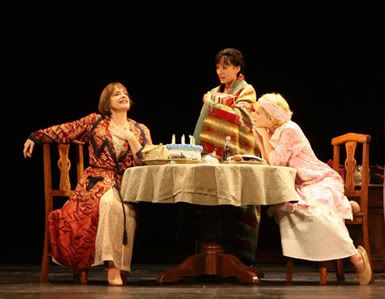
If a piece of art can do all that, you have to call it perfect.
Here She is, Boys!
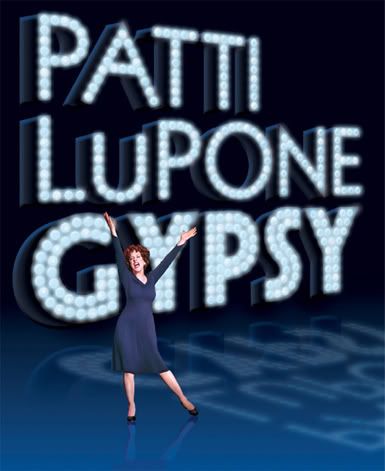
The temp page for the new Gypsy site is up. Apparently that's the official artwork which will soon be on the marquee, plus delis and cabs all over New York City. Yes, it's one of the fugliest things I've ever seen and, yes, it will be on my wall -- signed, sealed, and framed -- come late June.
03 January, 2008
New Songs?
I love Songs for a New World as much as any other musical theatre fan . . . probably more. As far as song cycles go, I've never heard better. As far as music goes, you'd be hard-pressed to find better. Jason Robert Brown has an unbelievable ability to create the most beautiful piano pieces out of the simplest sounds and his lyrics . . . holy crap, we're not even going into that. It will reduce me to some blathering pile of goo. Anyway, LOVE Songs for a New World . . . until the strings come in.
What? Strings? you say. I though you loved strings! I thought they made you spazz and flail like nothing else and profess your undying love for the composer and/or musician, sometimes to their faces, even if they're complete strangers!
This is all very true. The problem is the strings on the cast recording aren't real strings. They are electronically reproduced strings. I used to just blow it off as me being picky, but then I got this really kick ass pair of headphones (Grado SR60) for Christmas. Songs sounds RIDICULOUSLY amazing on these babies. Like, so-good-it-should-be-illegal amazing. And then the fake!strings come in and it makes me want to cry. The difference between the real!instruments and fake!strings is quite distressing. Having heard it live with real cellos and violins, the fake!strings are even sadder. ESPECIALLY in "Hear My Song" when the strings come in at the climax and because of the dorkiness, the climax just doesn't work.
So I want a new recording. Please? Because, clearly, the Broadway gods listen to me. Just for kicks, my dream cast:
Laura Benanti as Woman 1 - her "Christmas Lullaby" is one of the most beautiful things I've ever heard.
Alice Ripley as Woman 2 - her "Flagmaker, 1775" would -- I don't even want to think about how amazing that would be.
Norm Lewis as Man 1 - listen to "You Should Be Loved" from Side Show and just TRY to tell me his "King of the World" won't kick your ass from here to doomsday.
Norbert Leo Butz as Man 2 - arguably the most talented actor on Broadway right now with a chocolaty smooth voice that just spills from his lips. Delicious. A little "I'd Give It All For You" from him and I'm a goner.
Eh, like it'll ever happen. But a girl can dream, can't she?
What? Strings? you say. I though you loved strings! I thought they made you spazz and flail like nothing else and profess your undying love for the composer and/or musician, sometimes to their faces, even if they're complete strangers!
This is all very true. The problem is the strings on the cast recording aren't real strings. They are electronically reproduced strings. I used to just blow it off as me being picky, but then I got this really kick ass pair of headphones (Grado SR60) for Christmas. Songs sounds RIDICULOUSLY amazing on these babies. Like, so-good-it-should-be-illegal amazing. And then the fake!strings come in and it makes me want to cry. The difference between the real!instruments and fake!strings is quite distressing. Having heard it live with real cellos and violins, the fake!strings are even sadder. ESPECIALLY in "Hear My Song" when the strings come in at the climax and because of the dorkiness, the climax just doesn't work.
So I want a new recording. Please? Because, clearly, the Broadway gods listen to me. Just for kicks, my dream cast:
Laura Benanti as Woman 1 - her "Christmas Lullaby" is one of the most beautiful things I've ever heard.
Alice Ripley as Woman 2 - her "Flagmaker, 1775" would -- I don't even want to think about how amazing that would be.
Norm Lewis as Man 1 - listen to "You Should Be Loved" from Side Show and just TRY to tell me his "King of the World" won't kick your ass from here to doomsday.
Norbert Leo Butz as Man 2 - arguably the most talented actor on Broadway right now with a chocolaty smooth voice that just spills from his lips. Delicious. A little "I'd Give It All For You" from him and I'm a goner.
Eh, like it'll ever happen. But a girl can dream, can't she?
29 December, 2007

24 December, 2007
Swing Your Razor Wide
Check out my review of Tim Burton's new Sweeney Todd film at Patrol Magazine, here. Oh, and, not to gloat or anything, but I'd like to say that I called it right way back in June of 2006.
20 December, 2007
It's Back, Baby!
It's Official: 'Gypsy' Opens March 27 with LuPone, Gaines & Benanti
And I plan on making a trip to see this thing (more than once) over Tony weekend in June. And there will, in all likelihood, be a cast recording, which is good for the soul. And I can't wait.
(All of the above is a significant understatement.)
19 December, 2007
All You Have to Do is Listen
There have only been two times in my life where a movie 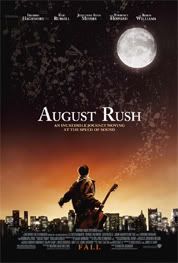 or theatrical performance has been so amazing that I’ve been forced to sit in my seat for some time after it's ended, too emotionally drained to move. The first time was at the City Center’s Encores! presentation of Gypsy last summer. The second happened last night when I saw August Rush. It’s not that either of these stories have any particular thing in common, except that they ring remarkably true and are so beautifully executed that they leave the viewer wholly satisfied and thoroughly exhausted.
August Rush is a story of a boy who wants to be found – a boy who understands that the universe doesn’t operate around red tape or on the mere “laws” of nature and logic. This young orphan boy knows that beyond our pretense of human control, something else holds the universe together. He understands that God draws straight with crooked lines. The odds are morally, logically, and common sensically against him. Who finds his lost parents through music? Lost parents who don’t even know he exists? No one. But August goes on believing. It’s this faith that brings him through. And it’s the same faith – lost and regained – that brings his parents to him.
August Rush won’t surprise you with plot twists or special effects or trips to magical lands. What it will do is cause you to look for the story in your life and the music that constantly swirls around you. It will show you that there is enough magic in this world that inhabitants from other so-called magical lands should be beating down the door to get into ours.
or theatrical performance has been so amazing that I’ve been forced to sit in my seat for some time after it's ended, too emotionally drained to move. The first time was at the City Center’s Encores! presentation of Gypsy last summer. The second happened last night when I saw August Rush. It’s not that either of these stories have any particular thing in common, except that they ring remarkably true and are so beautifully executed that they leave the viewer wholly satisfied and thoroughly exhausted.August Rush is a story of a boy who wants to be found – a boy who understands that the universe doesn’t operate around red tape or on the mere “laws” of nature and logic. This young orphan boy knows that beyond our pretense of human control, something else holds the universe together. He understands that God draws straight with crooked lines. The odds are morally, logically, and common sensically against him. Who finds his lost parents through music? Lost parents who don’t even know he exists? No one. But August goes on believing. It’s this faith that brings him through. And it’s the same faith – lost and regained – that brings his parents to him.
August Rush won’t surprise you with plot twists or special effects or trips to magical lands. What it will do is cause you to look for the story in your life and the music that constantly swirls around you. It will show you that there is enough magic in this world that inhabitants from other so-called magical lands should be beating down the door to get into ours.
01 August, 2007
Curtain Up! Light the Lights!
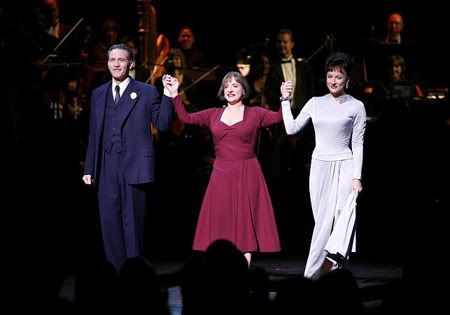
I’ve been trying for two days now to collect my thoughts and write something intelligent about the brilliance I saw at the City Center last week. Unfortunately for you, that particular production of Gypsy reduces me to a spazzing, sobbing mess of a theatre freak. I figure since the show has closed, a glowing review won’t do any good anyway, so this will have to do:
The City Center’s Encores! production of Gypsy was the single greatest theatrical experience of my short life. As a result of its perfection, I will never again be able to see this show. The lack of Laura Benanti, Patti Lupone, Boyd Gaines and, really, the entire cast (down to each cute little newsboy) would cause me to walk out of the theatre in a completely irrational state of disgust. To put it simply, this production will never be matched, let alone surpassed, so I’ll leave it in my memory to pull out on a rainy day.
The City Center’s Encores! production of Gypsy was the single greatest theatrical experience of my short life. As a result of its perfection, I will never again be able to see this show. The lack of Laura Benanti, Patti Lupone, Boyd Gaines and, really, the entire cast (down to each cute little newsboy) would cause me to walk out of the theatre in a completely irrational state of disgust. To put it simply, this production will never be matched, let alone surpassed, so I’ll leave it in my memory to pull out on a rainy day.
10 July, 2007
Reverent Blasphemy
Truly excellent theatre is a transforming experience. So transforming that I’d go so far as to call it a religious experience. By saying this I don’t intend to be blasphemous, but, insofar as God created this world so that everything points to Him, theatre is as close to heaven as a person can get here on earth, the Sabbath not withstanding.
Our lives are just a minuscule part of the One, Great Story, written by the Divine Playwright. Excellent theatre reflects His story. It pulls out one of the many threads, examines it, expounds on it, and causes us to search for those threads in our everyday lives. It snatches characters from swathes of humanity and exaggerates archetypes for our entertainment and edification. It is putting the magnifying glass to God’s work of Creation and causing others to wonder at it.
But why theatre, especially? Why not film, or television, or music even? Because theatre is up close, in your face, live, and in person. It is more real. The energy – the life – is palpable because it’s right there in front of your face – oftentimes no more than ten feet away – and you absolutely can’t deny it. Those are real tears you see and you’re almost close enough to wipe them away with your own hand. That fire in his eyes can and will burn through your soul. The tragedy, comedy, and reality you see displayed before your very eyes is enough to transform your perspective on the tragedy and comedy in your own life, and praise God accordingly.
Our lives are just a minuscule part of the One, Great Story, written by the Divine Playwright. Excellent theatre reflects His story. It pulls out one of the many threads, examines it, expounds on it, and causes us to search for those threads in our everyday lives. It snatches characters from swathes of humanity and exaggerates archetypes for our entertainment and edification. It is putting the magnifying glass to God’s work of Creation and causing others to wonder at it.
But why theatre, especially? Why not film, or television, or music even? Because theatre is up close, in your face, live, and in person. It is more real. The energy – the life – is palpable because it’s right there in front of your face – oftentimes no more than ten feet away – and you absolutely can’t deny it. Those are real tears you see and you’re almost close enough to wipe them away with your own hand. That fire in his eyes can and will burn through your soul. The tragedy, comedy, and reality you see displayed before your very eyes is enough to transform your perspective on the tragedy and comedy in your own life, and praise God accordingly.
13 June, 2007
To Be or Not to Be
Raul Esparza was robbed, they say. But I’m not so sure.
They say that he, having been long overlooked by the Tony committee, was due. This was his year. But last time I checked, the award was for Best Leading Actor in a Musical, not Best Leading Vocalist in a Musical.
I would gladly go out of my way to praise Esparza for his performance on the Tony Awards this year. I’ve never found occasion to like him before, but the passion and longing he conveyed -- not to mention the sheer power of his voice -- won me over. It gave me chills and caused me to lose control of the muscles that keep my jaw shut. Nevertheless, as I watched, I couldn’t help noticing how much effort it seemed to take him to sing it. It took me awhile to realize why that bugged me.
In musical theatre, song is a natural extension of the character. When some event, thought, or feeling is too much for the non-metrical monotony of everyday speech, the characters simply must burst into song. As a result, the actor must make it look natural . . . effortless. Take a look at four-time Tony winner Audra McDonald, for example. You wouldn’t expect such a voice to come out of her with the way she presents herself. Each high note seems to take no more effort than an everyday discourse between friends; each one slides out of her mouth like water down a gently sloping hill. Then there’s Esparaza. Every power note, every long note –- especially that high note at the end of “Being Alive” –- that Esparza sings is preceded by a noticeable effort, as sort of gearing up for the big’un.
David Hyde Pierce, though he had an arguably less difficult and certainly less nuanced part in Curtians, did a much better job of hiding his effort. He was Lieutenant Cioffi because we didn’t see him trying to be Lieutenant Cioffi. Esparza did a bang up job as Bobby, but we all knew he was trying. Yes, the role of tortured, lonely Bobby seems to require more effort that the romantic, stage-struck Cioffi, but both should appear just as effortless to the audience.
That is where Esparza failed and Pierce succeeded. And that is why Pierce walked away with the shiny, spinning statue.
They say that he, having been long overlooked by the Tony committee, was due. This was his year. But last time I checked, the award was for Best Leading Actor in a Musical, not Best Leading Vocalist in a Musical.
I would gladly go out of my way to praise Esparza for his performance on the Tony Awards this year. I’ve never found occasion to like him before, but the passion and longing he conveyed -- not to mention the sheer power of his voice -- won me over. It gave me chills and caused me to lose control of the muscles that keep my jaw shut. Nevertheless, as I watched, I couldn’t help noticing how much effort it seemed to take him to sing it. It took me awhile to realize why that bugged me.
In musical theatre, song is a natural extension of the character. When some event, thought, or feeling is too much for the non-metrical monotony of everyday speech, the characters simply must burst into song. As a result, the actor must make it look natural . . . effortless. Take a look at four-time Tony winner Audra McDonald, for example. You wouldn’t expect such a voice to come out of her with the way she presents herself. Each high note seems to take no more effort than an everyday discourse between friends; each one slides out of her mouth like water down a gently sloping hill. Then there’s Esparaza. Every power note, every long note –- especially that high note at the end of “Being Alive” –- that Esparza sings is preceded by a noticeable effort, as sort of gearing up for the big’un.
David Hyde Pierce, though he had an arguably less difficult and certainly less nuanced part in Curtians, did a much better job of hiding his effort. He was Lieutenant Cioffi because we didn’t see him trying to be Lieutenant Cioffi. Esparza did a bang up job as Bobby, but we all knew he was trying. Yes, the role of tortured, lonely Bobby seems to require more effort that the romantic, stage-struck Cioffi, but both should appear just as effortless to the audience.
That is where Esparza failed and Pierce succeeded. And that is why Pierce walked away with the shiny, spinning statue.
08 June, 2007
Accidental Profundity
"The great artists of the theater's Golden Era -- many of whom would have scoffed at that characterization of themselves and insisted instead that they were craftsmen [...] applied themselves to the modest and deeply difficult goal of creating work that was entertaining, and so, they invariably, and often inadvertently, created work that was profound." (Peter Birkenhead, Give my petards to Broadway, June 8, 2007)
Homegrown Theatre Terrorists
"[T]he theater has been hijacked. It's been commandeered by grant-proposal writers and dramaturges, by panel-discussion moderators and chin-in-hand bureaucrats, many of whom brook no more dissent than the Bush administration." (Peter Birkenhead, Give my petards to Broadway, June 8, 2007)
07 June, 2007
A Must See
If this doesn't make a person want to see Grey Gardens, I don't know what would.
Christine Ebersole is gem and if she doesn't win the Tony this year, there is something very, very wrong with the world.
Christine Ebersole is gem and if she doesn't win the Tony this year, there is something very, very wrong with the world.
26 May, 2007
Mrs. Lovett/Mr. Lovett
Those on the BroadwayWorld.com message boards have recently been discussing the possibility of men playing women’s roles – not in drag, but as men. Most don’t see a problem, calling the idea “interesting,” “fun,” or “a challenge for the actors.” Interest, fun, and experiment are all well and good, but these folks are missing the point entirely:
Story.
At its heart, theatre is telling a story – live and in front of people. Stories can be anywhere from devastatingly bad to unbelievably excellent. The excellent stories – the ones that grip your imagination and won’t let it go, the ones that leave you completely satisfied, yet yearning for more – those are the stories that stay within the vast bounds of truth. Stories with myriads of characters, all archetypes, but all unique. Characters who have their own voice, quirks, pet peeves, obsessions, and joys interacting with characters who have a completely different voice and set of circumstances. Characters who could never swap places with another without drastically changing the story. You wouldn’t dare say that Macbeth and Hamlet are interchangeable, or even Rosencrantz and Guildenstern, for that matter.
These irreplaceable characters, just like us, are shaped by their unique backgrounds, and that includes gender. No matter what the latest postmodern thinker tries to tell you, men and women are inherently different. “So God created man in His own image, in the image of God He created him; male and female He created them.” But we need no Biblical declaration or scientific study to tell us what we can easily discern by fifteen minutes of watching children on a playground. Boys and girls think differently, react differently, and grow differently.
And that is why Mrs. Lovett could never legitimately be a Mr. Lovett. A Mr. Lovett, gay or not, would have a completely different back story and would react to situations in a wildly different way than Mrs. Lovett. Switching genders would change Lovett’s relationship with Toby from a creepy motherly one to God knows what and Lovett’s relationship with Sweeney to some weird gay/straight/straight love triangle. Instead of the exploration of vengeance that the show is, it would become some exploration of political correctness and gay propaganda in a backdrop of horror. And that, needless to say, was not the author’s intention.
Good writers weave their stories very carefully. Everything becomes intentional, often down to the color of a person’s hair or a well-placed comma. Changing even the littlest thing can change the truth of a story and diminish its excellence. If you want to write some gay love story, be my guest, but don’t ruin the excellent stories of others for your own personal crusade.
Story.
At its heart, theatre is telling a story – live and in front of people. Stories can be anywhere from devastatingly bad to unbelievably excellent. The excellent stories – the ones that grip your imagination and won’t let it go, the ones that leave you completely satisfied, yet yearning for more – those are the stories that stay within the vast bounds of truth. Stories with myriads of characters, all archetypes, but all unique. Characters who have their own voice, quirks, pet peeves, obsessions, and joys interacting with characters who have a completely different voice and set of circumstances. Characters who could never swap places with another without drastically changing the story. You wouldn’t dare say that Macbeth and Hamlet are interchangeable, or even Rosencrantz and Guildenstern, for that matter.
These irreplaceable characters, just like us, are shaped by their unique backgrounds, and that includes gender. No matter what the latest postmodern thinker tries to tell you, men and women are inherently different. “So God created man in His own image, in the image of God He created him; male and female He created them.” But we need no Biblical declaration or scientific study to tell us what we can easily discern by fifteen minutes of watching children on a playground. Boys and girls think differently, react differently, and grow differently.
And that is why Mrs. Lovett could never legitimately be a Mr. Lovett. A Mr. Lovett, gay or not, would have a completely different back story and would react to situations in a wildly different way than Mrs. Lovett. Switching genders would change Lovett’s relationship with Toby from a creepy motherly one to God knows what and Lovett’s relationship with Sweeney to some weird gay/straight/straight love triangle. Instead of the exploration of vengeance that the show is, it would become some exploration of political correctness and gay propaganda in a backdrop of horror. And that, needless to say, was not the author’s intention.
Good writers weave their stories very carefully. Everything becomes intentional, often down to the color of a person’s hair or a well-placed comma. Changing even the littlest thing can change the truth of a story and diminish its excellence. If you want to write some gay love story, be my guest, but don’t ruin the excellent stories of others for your own personal crusade.
25 May, 2007
Spring Awakening Abridged
Gotta love BroadwayAbridged.com. Here's Mr. Varod slaughtering Spring Awakening with sharp and hilarious satire.
23 May, 2007
I Don't Do Foulness
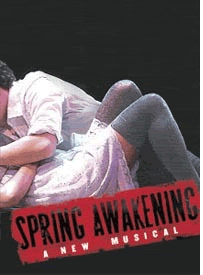 You might be wondering why I haven’t followed the theatre world at large in writing a gushing recommendation of Spring Awakening. After all, it did garner 11 Tony nominations (that’s every eligible category but two) and 4 Drama Desk Awards, including Outstanding Musical. That’s gotta be good for something, right? Well, that depends on who you ask.
New York Times theatre critic Charles Isherwood will give you some drivel about adolescent sexual discovery, other critics will drone on about raw teen angst, and message board theatre queens will overwhelm you with effusions about how there’s “finally” a show that “really gets” them. That is, as you may recall, the same thing they said about Hair and RENT in their heydays. And like RENT, Spring Awakening does have some truly catchy songs. “Mama Who Bore Me” captures an insistence and a certain measure of angst that few composers have been able to, including the marvelous dissonances in its reprise. Unfortunately, the lyrics fail to tell us what the characters are insistent about or where their angst is coming from. Oops.
The other notable song is the regrettably lyriked “The Bitch of Living.” It’s one of the catchiest tunes I’ve heard on Broadway this season, but it falls into the trap of assuming foul language and artistic genius are synonymous.
It’s this overall foulness that prevents me from recommending it. The taglines alone are enough to warn discerning theatergoers. “A barrier-breaking fusion of morality, sexuality, and rock & roll.” “A story of uncontrollable emotions and undeniable passion, of first love and lasting regrets.” There’s not much redeemable in a story about “sexually repressed” 14-year-olds who get into all sorts of trouble because of their ignorance, including having the sex they’ve been repressing (you get to see it, too!), masturbation (live, and on stage!), pregnancy, botched abortion, and suicide.
Overall, Spring Awakening is so antithetical to truth, goodness, and beauty that it has become the best argument for theatrical reformation. If you want to see truly great theatre, save yourself the airfare and catch the tour of The Light in the Piazza.
22 May, 2007
Shepherding Boredom
The Good Shepherd is a really long movie. For a film about the genesis of the CIA, it has about as much intrigue as a small town farmer's convention. I was was so bored, I actually shut it off halfway through. I'll never know what the payoff is (if there is one), but I'm certainly not fretting over it.
18 June, 2006
Come and visit your good friend Sweeney . . .
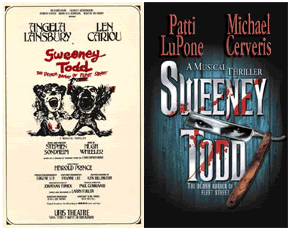
Many in the theatre community are up in arms over the proposed film adaptation of Stephen Sondheim’s Sweeney Todd. Among the complaints: 1) it shouldn’t be a movie; 2) Tim Burton is an inappropriate direction choice; and 3) Johnny Depp would make a bad Sweeney. But I ask you to cast aside your worries for the time-being and listen to what I have to say.
Complaint Number One: Sweeney Todd is a stage musical and shouldn’t be made into a movie. Of the three complaints listed, this one holds the most water. Ever since the horrible film adaptations of some of my favorite books, I’ve been very wary of the adaptation phenomenon. But in most cases, the authors of my favorite books are dead and, therefore, have no say in the adaptation process. In the case of Sweeney Todd, Mr. Sondheim is still alive and composing and even consulted the cast and crew of the new Broadway revival of the very show we’re speaking of. Since Mr. Sondheim is still with us, he may very well also help out with this production of (what I consider) his masterpiece.
Another hurdle in the adaptation process is the fact that Sweeney is a very theatrical piece, with over-the-top numbers and nearly-operatic climaxes unfit for the confining silver screen. As much as I would hate to see some of Sondheim’s best music get the axe, an easy way to make numbers like “Epiphany” work on film would be to turn them into underscored dialogue, which I will touch on in more detail later.
The last hurdle in the adaptation process is the director, which is where Complaint Number Two comes in: Tim Burton’s direction style is not right for Sweeney Todd; his films are too cartoonish. Tim Burton strikes me as a very intelligent director with a distinct vision for every movie he makes and that is precisely why this partnership will work. Sondheim’s Sweeney Todd’s is so remarkably written in every sense, that as long as the substance remains the same, a director can do nearly anything he wants with theme or style, especially if he is such a distinct visionary like Mr. Burton. Just look at the two Broadway productions we’ve seen. Under Hal Prince’s direction, Sweeney was a tale of social injustice told in a modern sort of expressionistic style while John Doyle’s recent production takes a closer look at the story’s psychological underpinnings. Prince’s stage was large with a metallic and industrial looking set while Doyle works with a small stage  and a minimalist set with very few props. Even the orchestrations and casts are very different. Prince had a 27-piece orchestra while Doyle cut it down to nine. Prince worked with a large chorus in addition to the main characters while Doyle’s cast of ten serves as both the established characters and the chorus. Even the characters are portrayed differently in Doyle’s production: a more introverted Sweeney, a sexier Mrs. Lovett, and woman as Pirelli. And yet, with all these differences, the story still shines through and the story is what’s most important. Don’t write off Mr. Burton quite yet.
All that remains in dispute is Complaint Number Three: Johnny Depp would make a horrible Sweeney. My first response to this would be, “ARE YOU INSANE?! HAVE YOU NEVER SEEN THE GUY ACT BEFORE?!” But that, of course, is not the most intelligent of arguments, so I suppose I’ll have to support it with some actual logic. First, Tim Burton is directing this film and, for whatever reason, he and Depp have an uncanny understanding of each other, such that their movies tend to turn out better-than-well. It is very true that we don’t know whether or not Depp can sing any Sondheim score, let a alone the tremendous difficulty of Sweeney Todd’s score, but think of it this way: If Burton decides (as rumored) to convert some of the more theatrical songs to underscored dialogue, Johnny Depp is the best possible choice for the role of Sweeney Todd. If you think Michael Cerveris makes an introverted and contemplative Sweeney, just wait until you see Johnny Depp. I can just picture him stepping outside his barber shop on Fleet Street, whispering maliciously to himself as he surveys the crowd below, “All right . . . you sir! How about a shave? Come and visit your good friend Sweeney. Ah! You too, sir! Welcome to the grave.” It could work marvelously.
I’m not saying this will be a perfect adaptation, or even a suitable one at that, but there’s no way of knowing until it’s made. All I’m saying is that we have plenty of information that hopefully points to a good adaptation. Just give it a chance.
Subscribe to:
Posts (Atom)