Or, Why In the Heights Won Best Musical and Passing Strange Walked Away with Next to Nothing
The 2008 Tony Awards renewed my hope for the future of musical theatre and it wasn’t simply the fact that the Tony voters actually selected the best in each category this year. It was the spectacle of The Lion King’s opening performance, the indomitable Patti LuPone garnering a standing ovation for her performance of "Everything’s Coming Up Roses," the reaction of generations of theatre people to RENT’s farewell performance, and the large number of winners who stood on stage expressing their sincere gratitude for just being allowed to work in theatre. But, most of all, it was the fact that the Lin-Manuel Mirandas took the night with barely a glance back at Stew and his attempt at the autonomous musical.
Just looking at Stew, the creator and self-styled star of the mostly autobiographical Passing Strange, is enough to see how full of himself the man is. Sporting ever present sunglasses, a bright wardrobe, and an irritating take-me-as-I-am personality, Stew announced to the New York Times, as if it were a badge of honor, that he can count the number of times he’s been to the theatre on one hand. He speaks about musical theatre as if it were the most inferior of art forms, in need of his vulgar, over-loud version of reform. "In high school," he said, "when you're a rock 'n' roll stoner, your mortal enemies are the thespians. We thought that musical theater was the dorkiest thing in the world and had nothing to do with the music we listened to. And quite frankly we still feel that way." With all his talk about being an "outsider," one gets the overall impression that the man enjoys being on the fringe and will do all he can to remain there, as if appealing to a wider variety of people were some form of selling out.
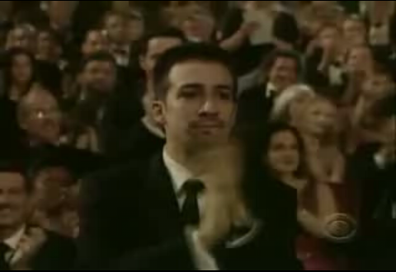
Then there’s Lin-Manuel Miranda. Being a Latino on Broadway, Miranda is also a minority; what Stew would call an "outsider." But where Stew harbors this not-so-veiled dislike for Broadway, Miranda is a Broadway baby. He may have grown up in the mostly Latino community of Inwood at the top of Manhattan, with all its hip-hop and salsa influences, but just watching his reaction to the RENT tribute performance is enough to see how much he adores musical theatre. Like many Broadway fans his age, his first show was The Phantom of the Opera and his first Broadway obsession, RENT. It was only right that this theatre fanboy took home some of the biggest awards of the evening. Upon winning for an original score riddled with homages to shows like West Side Story, he burst into an unrehearsed rap and gave some love to Sunday in the Park with George, exclaiming, "Mr. Sondheim, look, I made a hat where there never was a hat! It's a Latin hat at that!"
Miranda did what every good creator does: he loved what came before. In bringing that love together with his love for the present, he created an old-fashioned show that nevertheless "illuminates the stories of the people in the street."
Showing posts with label excellence. Show all posts
Showing posts with label excellence. Show all posts
04 July, 2008


27 June, 2008
No Day But Today
I’ve never liked RENT. I still don’t. I think it is an objectively bad musical, poorly constructed, full of annoying songs and trite lyrics, and just barely carried out with flair. My dislike for this musical has embittered me against the oft-repeated refrain, “RENT was a revolutionary musical that changed the face of theatre forever.”
Then Tony night happened.
Since the Broadway production of RENT is closing this September, the powers that be brought the original and current casts together on the same stage for the 2008 Tony Awards in tribute to the show that “changed the face of Broadway.” They sang a “La Vie Boheme”/”Seasons of Love” medley and it wasn’t until they showed the audience reaction that I understood just what sort of impact RENT has had on the Broadway community. Among others, Sunday in the Park with George star Daniel Evans sat there grinning and singing along like the fan boy I now suspect he is and Patti LuPone herself was actually rocking out in her seat. These aren’t rabid, thirteen-year-old fangirls; these are industry professionals. But the most glorious moment – the moment that forever changed my perception of RENT – came when the old and new casts had barely finished singing and Lin-Manuel Miranda leapt to his feet, barely able to contain his tears of joy. It was then that I realized that the creation of In the Heights can be traced back directly to RENT.
Thank you, Jonathan Larson.
Then Tony night happened.
Since the Broadway production of RENT is closing this September, the powers that be brought the original and current casts together on the same stage for the 2008 Tony Awards in tribute to the show that “changed the face of Broadway.” They sang a “La Vie Boheme”/”Seasons of Love” medley and it wasn’t until they showed the audience reaction that I understood just what sort of impact RENT has had on the Broadway community. Among others, Sunday in the Park with George star Daniel Evans sat there grinning and singing along like the fan boy I now suspect he is and Patti LuPone herself was actually rocking out in her seat. These aren’t rabid, thirteen-year-old fangirls; these are industry professionals. But the most glorious moment – the moment that forever changed my perception of RENT – came when the old and new casts had barely finished singing and Lin-Manuel Miranda leapt to his feet, barely able to contain his tears of joy. It was then that I realized that the creation of In the Heights can be traced back directly to RENT.
Thank you, Jonathan Larson.
26 June, 2008
Another Hundred People Just Got off of the Train
Yes, I did in fact go to NYC and make it back alive. The only reason I haven't written anything about it yet is because my real life decided to just start back up again right where I left it. Long story short, it was a theatre marathon and nearly as tiring as an actual marathon, but oh so satisfying.
Despite missing the first twenty minutes of In the Heights because United Airlines has the crappiest service in the history of the industry, the show was great and I had a great time with my aunt and uncle. That Saturday will go down as one the most memorable of my life because, after the show, I my aunt and uncle took me to dinner at The View and then I saw August: Osage County. If you enjoy really spectacularly excellent theatre -- the kind that leaves you breathless and screaming with delight all at once -- you have to go see it. Marvelous.
Then I had a Gypsy marathon comprised of the Sunday matinée, the best Tony Awards ever, a small Broadway by the Year - 1979 interruption on Monday night, the Tuesday evening show, and the Wednesday matinée. And the show got better every time I saw it and the dressing room fight at the end changed each night. But not like they were bored or goofing off. They were EXPLORING. It was brilliant. And Tuesday night's performance -- the one right after the cast won their respective Tony Awards -- was a performance that will live on as the most memorable show I've ever been too. Such entrance applause! And Laura breaking character (which she never does) and crying because of it. The intensity of the dressing room fight made me feel nauseated and "Rose's Turn" made me want to curl up in a corner and cry like a baby; Rose's hair was flying loose, she spat her words like snake venom, and then proceeded to have a complete nervous breakdown before my very eyes and I loved. Every. Second of it. Then I sat front row center on Wednesday afternoon, which really wasn't a good idea because Patti hit me in the face with the torn up letter at the end of "Everything's Coming Up Roses" and I almost died. No. Really. Front row is really too close for comfort if you get as emotionally involved as I do. I was on the verge of a heart attack from the train station scene on through the end. Ugh. I hate that show. And by "hate" I mean "love". Clearly.
Then I ended my trip with the jaw exercise that is the sweet show, Curtains. I have never smiled, laughed, and cried so much in a theatre in all my life. It was SO CUTE. Just a grand, old fashioned show with a lot of heart. I loved it. And we sat front row center (technically partial view, but not really), which made the stage door a bit embarrassing when half the cast recognized us. Oops. I'm so sad that it closes on Sunday. It's such a happy little show.
Anyway, great trip. And real live reviews will be coming soon, since I have the rest of the week off.
Despite missing the first twenty minutes of In the Heights because United Airlines has the crappiest service in the history of the industry, the show was great and I had a great time with my aunt and uncle. That Saturday will go down as one the most memorable of my life because, after the show, I my aunt and uncle took me to dinner at The View and then I saw August: Osage County. If you enjoy really spectacularly excellent theatre -- the kind that leaves you breathless and screaming with delight all at once -- you have to go see it. Marvelous.
Then I had a Gypsy marathon comprised of the Sunday matinée, the best Tony Awards ever, a small Broadway by the Year - 1979 interruption on Monday night, the Tuesday evening show, and the Wednesday matinée. And the show got better every time I saw it and the dressing room fight at the end changed each night. But not like they were bored or goofing off. They were EXPLORING. It was brilliant. And Tuesday night's performance -- the one right after the cast won their respective Tony Awards -- was a performance that will live on as the most memorable show I've ever been too. Such entrance applause! And Laura breaking character (which she never does) and crying because of it. The intensity of the dressing room fight made me feel nauseated and "Rose's Turn" made me want to curl up in a corner and cry like a baby; Rose's hair was flying loose, she spat her words like snake venom, and then proceeded to have a complete nervous breakdown before my very eyes and I loved. Every. Second of it. Then I sat front row center on Wednesday afternoon, which really wasn't a good idea because Patti hit me in the face with the torn up letter at the end of "Everything's Coming Up Roses" and I almost died. No. Really. Front row is really too close for comfort if you get as emotionally involved as I do. I was on the verge of a heart attack from the train station scene on through the end. Ugh. I hate that show. And by "hate" I mean "love". Clearly.
Then I ended my trip with the jaw exercise that is the sweet show, Curtains. I have never smiled, laughed, and cried so much in a theatre in all my life. It was SO CUTE. Just a grand, old fashioned show with a lot of heart. I loved it. And we sat front row center (technically partial view, but not really), which made the stage door a bit embarrassing when half the cast recognized us. Oops. I'm so sad that it closes on Sunday. It's such a happy little show.
Anyway, great trip. And real live reviews will be coming soon, since I have the rest of the week off.
10 June, 2008
Revive Me
There's something that has always bugged me about the theatre community at large and that is the widespread hatred of revivals. Lately, it's been all about the Gypsy hate. Not out and out hatred, mind you. These bitchy theatre queens will be the fastest to confess their love for the great musical. It's the "endless" revivals they can't stand. "It was JUST on Broadway," they complain. "The public is sick of it!"
But the public certainly isn't sick of it. Much of America doesn't even know what the hell Gypsy is, or A Chorus Line, or Company. They couldn't care less that you think Barbara Walsh was so inferior to Elaine Stritch that she doesn't even deserve the time of day from you. What your American tourist cares about is seeing a good show. Furthermore, and more importantly, what your teenage Broadway enthusiast ALSO cares about is seeing a good show. That 13-year-old who just got her socks blown off by Patti LuPone didn't get the chance to see Bernadette Peters in the very same role five years ago. And even if she did, she wouldn't have understood a lick of it.
Theatre by its very nature is a cultural art form. In order for the young'uns to know what is good, they must be enculturated with the good stuff. And that means revivals. It may all seem tiresome to someone who's been going to the theatre for thirty-some-odd years, but it's necessary to raise up the next generation of theatregoers, performers, directors, producers, and creators. Yes, new works are exhilarating. But you can't truly appreciate a new musical's newness until you've enjoyed what's come before.
So, when ten years from now Gypsy is revived again (Emily Skinner as Rose, anyone?), instead of complaining, stand outside the theatre as the show lets out and look at the faces of the young people who will have just seen it for the first time EVER. You'll no longer see a reason to complain.
But the public certainly isn't sick of it. Much of America doesn't even know what the hell Gypsy is, or A Chorus Line, or Company. They couldn't care less that you think Barbara Walsh was so inferior to Elaine Stritch that she doesn't even deserve the time of day from you. What your American tourist cares about is seeing a good show. Furthermore, and more importantly, what your teenage Broadway enthusiast ALSO cares about is seeing a good show. That 13-year-old who just got her socks blown off by Patti LuPone didn't get the chance to see Bernadette Peters in the very same role five years ago. And even if she did, she wouldn't have understood a lick of it.
Theatre by its very nature is a cultural art form. In order for the young'uns to know what is good, they must be enculturated with the good stuff. And that means revivals. It may all seem tiresome to someone who's been going to the theatre for thirty-some-odd years, but it's necessary to raise up the next generation of theatregoers, performers, directors, producers, and creators. Yes, new works are exhilarating. But you can't truly appreciate a new musical's newness until you've enjoyed what's come before.
So, when ten years from now Gypsy is revived again (Emily Skinner as Rose, anyone?), instead of complaining, stand outside the theatre as the show lets out and look at the faces of the young people who will have just seen it for the first time EVER. You'll no longer see a reason to complain.
07 June, 2008
Throw That Fairy Dust in My Hair
Sometimes I forget how much I love Stephanie J. Block. And then she sings "Never Never Land" again and I curse myself for ever forgetting.
Shoshana Bean gives and awkward and somewhat funny introduction, but feel free to ignore it and get to the good stuff. That being Stephanie acting the face off of Scott Alan's best song, "Never Never Land."
Shoshana Bean gives and awkward and somewhat funny introduction, but feel free to ignore it and get to the good stuff. That being Stephanie acting the face off of Scott Alan's best song, "Never Never Land."
So Good, It's Painful
As I've said before, my favorite shows or movies are the ones that leave me incapacitated at the end. Literally in pain. These include shows like Gypsy and Next to Normal and movies like August Rush. But the funny thing about Gypsy is sometimes I get sick to my stomach just thinking about it. I don't even have to be watching it or listening to the cast recording. Merely thinking about the fight in the dressing room or last two minutes of "Rose's Turn" or the mocking laughter that erupts from the venom Louise's own mother cultured in her daughter's gut . . . I can't even deal.
And somehow I'm going to see this show three times in a row. Pray for me. I might just die.
And somehow I'm going to see this show three times in a row. Pray for me. I might just die.
27 March, 2008
One Word: RAVE
So, here we are, Thursday night, March 27th, 2008 and the curtain just dropped at Gypsy at the St. James Theatre in New York City. The reviews are in and I couldn't have dreamed of anything better. Mostly raves with a good one thrown in for kicks. Not only did Variety adore it and TheaterMania practically trip over themselves trying to give the best compliments, but Ben Brantley of the New York Times was also among the rave reviewers:
"And Ms. Benanti, in the performance of her career, traces Louise’s path to becoming her mother’s daughter out of necessity. The transformation of the waifish Louise into the vulpine Gypsy Rose Lee is completely convincing. And you’re acutely aware of what’s lost and gained in the metamorphoses."
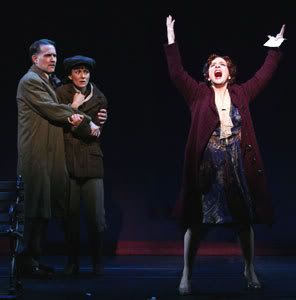
"When Ms. LuPone delivers “Rose’s Turn,” she’s building a bridge for an audience to walk right into one woman’s nervous breakdown. There is no separation at all between song and character, which is what happens in those uncommon moments when musicals reach upward to achieve their ideal reasons to be. This “Gypsy” spends much of its time in such intoxicating air."
Some of the truest stuff I've ever heard. My God, I love this show!
"And Ms. Benanti, in the performance of her career, traces Louise’s path to becoming her mother’s daughter out of necessity. The transformation of the waifish Louise into the vulpine Gypsy Rose Lee is completely convincing. And you’re acutely aware of what’s lost and gained in the metamorphoses."
"When Ms. LuPone delivers “Rose’s Turn,” she’s building a bridge for an audience to walk right into one woman’s nervous breakdown. There is no separation at all between song and character, which is what happens in those uncommon moments when musicals reach upward to achieve their ideal reasons to be. This “Gypsy” spends much of its time in such intoxicating air."
Some of the truest stuff I've ever heard. My God, I love this show!
08 January, 2008
Absolutely Perfectly Written. Period.
Some of you may be wondering, as I once did, what exactly it is that makes Gypsy the perfect American musical. How can this musical about an overbearing stage mother and her soon-to-be stripper daughter qualify as anything true, good, or beautiful?
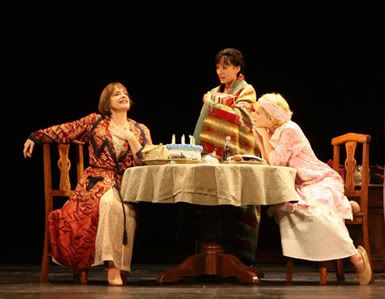
Putting your finger on perfection is a difficult task. It’s never the result of one thing, but all things working together, well, perfectly. It’s music, lyrics, and book flowing out of characters who think, act, and react just as a person would in real life. It’s capturing the essence of the universal in a series of specifics: the strange tension of competition and love between a mother and daughter, the destructive nature of love in the form of favoritism, and the male-female dynamic all exploding from the stage in a backstage story to end all backstage stories.
If a piece of art can do all that, you have to call it perfect.
Putting your finger on perfection is a difficult task. It’s never the result of one thing, but all things working together, well, perfectly. It’s music, lyrics, and book flowing out of characters who think, act, and react just as a person would in real life. It’s capturing the essence of the universal in a series of specifics: the strange tension of competition and love between a mother and daughter, the destructive nature of love in the form of favoritism, and the male-female dynamic all exploding from the stage in a backstage story to end all backstage stories.
If a piece of art can do all that, you have to call it perfect.
29 December, 2007

01 August, 2007
Curtain Up! Light the Lights!
I’ve been trying for two days now to collect my thoughts and write something intelligent about the brilliance I saw at the City Center last week. Unfortunately for you, that particular production of Gypsy reduces me to a spazzing, sobbing mess of a theatre freak. I figure since the show has closed, a glowing review won’t do any good anyway, so this will have to do:
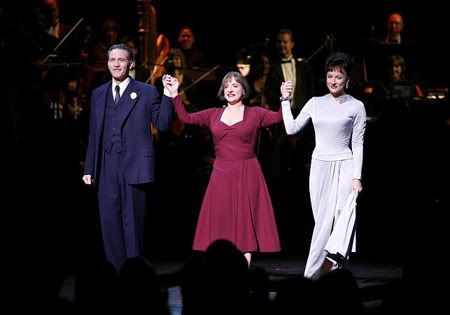
The City Center’s Encores! production of Gypsy was the single greatest theatrical experience of my short life. As a result of its perfection, I will never again be able to see this show. The lack of Laura Benanti, Patti Lupone, Boyd Gaines and, really, the entire cast (down to each cute little newsboy) would cause me to walk out of the theatre in a completely irrational state of disgust. To put it simply, this production will never be matched, let alone surpassed, so I’ll leave it in my memory to pull out on a rainy day.
The City Center’s Encores! production of Gypsy was the single greatest theatrical experience of my short life. As a result of its perfection, I will never again be able to see this show. The lack of Laura Benanti, Patti Lupone, Boyd Gaines and, really, the entire cast (down to each cute little newsboy) would cause me to walk out of the theatre in a completely irrational state of disgust. To put it simply, this production will never be matched, let alone surpassed, so I’ll leave it in my memory to pull out on a rainy day.
10 July, 2007
Reverent Blasphemy
Truly excellent theatre is a transforming experience. So transforming that I’d go so far as to call it a religious experience. By saying this I don’t intend to be blasphemous, but, insofar as God created this world so that everything points to Him, theatre is as close to heaven as a person can get here on earth, the Sabbath not withstanding.
Our lives are just a minuscule part of the One, Great Story, written by the Divine Playwright. Excellent theatre reflects His story. It pulls out one of the many threads, examines it, expounds on it, and causes us to search for those threads in our everyday lives. It snatches characters from swathes of humanity and exaggerates archetypes for our entertainment and edification. It is putting the magnifying glass to God’s work of Creation and causing others to wonder at it.
But why theatre, especially? Why not film, or television, or music even? Because theatre is up close, in your face, live, and in person. It is more real. The energy – the life – is palpable because it’s right there in front of your face – oftentimes no more than ten feet away – and you absolutely can’t deny it. Those are real tears you see and you’re almost close enough to wipe them away with your own hand. That fire in his eyes can and will burn through your soul. The tragedy, comedy, and reality you see displayed before your very eyes is enough to transform your perspective on the tragedy and comedy in your own life, and praise God accordingly.
Our lives are just a minuscule part of the One, Great Story, written by the Divine Playwright. Excellent theatre reflects His story. It pulls out one of the many threads, examines it, expounds on it, and causes us to search for those threads in our everyday lives. It snatches characters from swathes of humanity and exaggerates archetypes for our entertainment and edification. It is putting the magnifying glass to God’s work of Creation and causing others to wonder at it.
But why theatre, especially? Why not film, or television, or music even? Because theatre is up close, in your face, live, and in person. It is more real. The energy – the life – is palpable because it’s right there in front of your face – oftentimes no more than ten feet away – and you absolutely can’t deny it. Those are real tears you see and you’re almost close enough to wipe them away with your own hand. That fire in his eyes can and will burn through your soul. The tragedy, comedy, and reality you see displayed before your very eyes is enough to transform your perspective on the tragedy and comedy in your own life, and praise God accordingly.
13 June, 2007
To Be or Not to Be
Raul Esparza was robbed, they say. But I’m not so sure.
They say that he, having been long overlooked by the Tony committee, was due. This was his year. But last time I checked, the award was for Best Leading Actor in a Musical, not Best Leading Vocalist in a Musical.
I would gladly go out of my way to praise Esparza for his performance on the Tony Awards this year. I’ve never found occasion to like him before, but the passion and longing he conveyed -- not to mention the sheer power of his voice -- won me over. It gave me chills and caused me to lose control of the muscles that keep my jaw shut. Nevertheless, as I watched, I couldn’t help noticing how much effort it seemed to take him to sing it. It took me awhile to realize why that bugged me.
In musical theatre, song is a natural extension of the character. When some event, thought, or feeling is too much for the non-metrical monotony of everyday speech, the characters simply must burst into song. As a result, the actor must make it look natural . . . effortless. Take a look at four-time Tony winner Audra McDonald, for example. You wouldn’t expect such a voice to come out of her with the way she presents herself. Each high note seems to take no more effort than an everyday discourse between friends; each one slides out of her mouth like water down a gently sloping hill. Then there’s Esparaza. Every power note, every long note –- especially that high note at the end of “Being Alive” –- that Esparza sings is preceded by a noticeable effort, as sort of gearing up for the big’un.
David Hyde Pierce, though he had an arguably less difficult and certainly less nuanced part in Curtians, did a much better job of hiding his effort. He was Lieutenant Cioffi because we didn’t see him trying to be Lieutenant Cioffi. Esparza did a bang up job as Bobby, but we all knew he was trying. Yes, the role of tortured, lonely Bobby seems to require more effort that the romantic, stage-struck Cioffi, but both should appear just as effortless to the audience.
That is where Esparza failed and Pierce succeeded. And that is why Pierce walked away with the shiny, spinning statue.
They say that he, having been long overlooked by the Tony committee, was due. This was his year. But last time I checked, the award was for Best Leading Actor in a Musical, not Best Leading Vocalist in a Musical.
I would gladly go out of my way to praise Esparza for his performance on the Tony Awards this year. I’ve never found occasion to like him before, but the passion and longing he conveyed -- not to mention the sheer power of his voice -- won me over. It gave me chills and caused me to lose control of the muscles that keep my jaw shut. Nevertheless, as I watched, I couldn’t help noticing how much effort it seemed to take him to sing it. It took me awhile to realize why that bugged me.
In musical theatre, song is a natural extension of the character. When some event, thought, or feeling is too much for the non-metrical monotony of everyday speech, the characters simply must burst into song. As a result, the actor must make it look natural . . . effortless. Take a look at four-time Tony winner Audra McDonald, for example. You wouldn’t expect such a voice to come out of her with the way she presents herself. Each high note seems to take no more effort than an everyday discourse between friends; each one slides out of her mouth like water down a gently sloping hill. Then there’s Esparaza. Every power note, every long note –- especially that high note at the end of “Being Alive” –- that Esparza sings is preceded by a noticeable effort, as sort of gearing up for the big’un.
David Hyde Pierce, though he had an arguably less difficult and certainly less nuanced part in Curtians, did a much better job of hiding his effort. He was Lieutenant Cioffi because we didn’t see him trying to be Lieutenant Cioffi. Esparza did a bang up job as Bobby, but we all knew he was trying. Yes, the role of tortured, lonely Bobby seems to require more effort that the romantic, stage-struck Cioffi, but both should appear just as effortless to the audience.
That is where Esparza failed and Pierce succeeded. And that is why Pierce walked away with the shiny, spinning statue.
23 May, 2007
I Don't Do Foulness
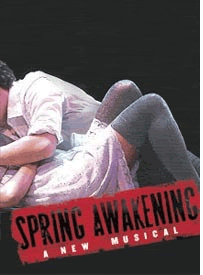 You might be wondering why I haven’t followed the theatre world at large in writing a gushing recommendation of Spring Awakening. After all, it did garner 11 Tony nominations (that’s every eligible category but two) and 4 Drama Desk Awards, including Outstanding Musical. That’s gotta be good for something, right? Well, that depends on who you ask.
New York Times theatre critic Charles Isherwood will give you some drivel about adolescent sexual discovery, other critics will drone on about raw teen angst, and message board theatre queens will overwhelm you with effusions about how there’s “finally” a show that “really gets” them. That is, as you may recall, the same thing they said about Hair and RENT in their heydays. And like RENT, Spring Awakening does have some truly catchy songs. “Mama Who Bore Me” captures an insistence and a certain measure of angst that few composers have been able to, including the marvelous dissonances in its reprise. Unfortunately, the lyrics fail to tell us what the characters are insistent about or where their angst is coming from. Oops.
The other notable song is the regrettably lyriked “The Bitch of Living.” It’s one of the catchiest tunes I’ve heard on Broadway this season, but it falls into the trap of assuming foul language and artistic genius are synonymous.
It’s this overall foulness that prevents me from recommending it. The taglines alone are enough to warn discerning theatergoers. “A barrier-breaking fusion of morality, sexuality, and rock & roll.” “A story of uncontrollable emotions and undeniable passion, of first love and lasting regrets.” There’s not much redeemable in a story about “sexually repressed” 14-year-olds who get into all sorts of trouble because of their ignorance, including having the sex they’ve been repressing (you get to see it, too!), masturbation (live, and on stage!), pregnancy, botched abortion, and suicide.
Overall, Spring Awakening is so antithetical to truth, goodness, and beauty that it has become the best argument for theatrical reformation. If you want to see truly great theatre, save yourself the airfare and catch the tour of The Light in the Piazza.
26 May, 2006
A "culture of transcendence" . . .
“Virtually all cultural institutions, from literature professors at Ivy League schools to producers of soap operas to the loudest heavy metal bands, are all equally bereft of points of perspective for their activities. In such a time the church could be a community displaying, in its corporate life and the lives of its members, a culture of transcendence. This would not mean escaping from the world. It would require refusing to conform to its ways, not only when they are evil, but when they are not beneficial or constructive.” (Kenneth A. Meyers, All God’s Children and Blue Suede Shoes, p. xvi)
30 March, 2006
Brick
I find the trailer for this film to be quite intriguing, though I'm not very sure what the movie is about. Focus Features has generally been a trustworthy studio. They produced such films as the new Pride & Prejudice, The Constant Gardener, Something New, Eternal Sunshine of the Spotless Mind, The Pianist, and Being John Malkovich. That's not to say they don't have some major failures -- if not commercially, then in my book -- like Gosford Park (though I may have to give it a second chance), Far From Heaven, and, most recently, Brokeback Mountain.
Their less-than-great endeavor's aside, Focus produces a larger percentage of movies that I enjoy than any other studio. It has been the pattern that those Focus trailers that intrigue me end up as films on my favorites list.
I've read a few conflicting reviews on the film, so I’m not sure I want to take the chance and spend six bucks on Brick in theaters, but I’m sure I'll tack it on to my excessively long Netflix queue come DVD time.
19 February, 2006
Female Empowerment? I Think Not.
Nathaniel Blake wrote an excellent article contrasting Eve Ensler (of The Vagina Monologues fame) and the impeccable Jane Austen. Well done.
07 February, 2006
24 January, 2006
The American Theatre Wing's Working in Theatre Seminars
Production: See What I Wanna See - 1:27:01
Now I really wish I'd SOMEHOW made it up to New York to see this show. God bless the ATW. I'd never realized how much they actually do for theatre and I hope they continue to hold and record these seminars.
20 January, 2006
The Recovery of Art at the End of the Spear?
When I first heard about End of the Spear (the new movie based on the real life story of the five missionaries killed in Ecuador by the indigenous Waodani tribe) I let out a tired groan, knowing that Christian production companies (this time it's Every Tribe Entertainment) have a tendency to produce artistically terrible stuff. I was dead set on not seeing it.
Recently, however, much of the evangelical community has been up in arms over the fact that Every Tribe hired not only a gay man (*gasp*) but a gay activist (*double gasp*) to play missionary Nate Saint and the grown up version of his son, Steve.
Oddly enough, this makes me want to see the movie.
I appreciate the fact that Every Tribe refused to brush off the actor with the best audition simply because he is gay and a gay activist. It shows that their focus is on making a good movie, rather than making politico-religious statements. I think this is the most Christian thing a Christian production company has ever done and, as a result, I will now be seeing what I hope will be an excellent movie.
29 December, 2005
Logical Foolishness
There is a very short, but packed, list of reasons why a Christian should not pursue a career in theatre and I have often struggled with my choice to pursue this career because of them. - Rehearsals and performances inevitably fall on the Lord's Day. Perhaps it is my tenacity, perhaps it is my enormous love for the theatre, or maybe it's just my stupidity, but, despite all the possible arguments against it, I can't seem to give up my pursuit.
- The number of roles and shows that do not compromise a Christian's principles continue to dwindle.
- A sort of unorganized "gay mafia" pulls the strings of Equity theatres forcing the Christian to speak carefully regarding his God's abhorrence of sodomy.
- A strange and disgusting sort of openness about sexuality pervades rehearsals and backstage during shows.
There is one thing that keeps me hanging on.
I've often heard it said that Christians should not pursue theatre today. My question is, if not today, then when? If Christians abandon the theatre world, not encouraging those with the talent -- maybe even the call -- to pursue what may be their vocation, then we have given over theatre to the pagans and Christians will never be able to participate.
The surrender is already happening. Christians, as a whole, have been withdrawing themselves from the theatre-at-large for a long time -- or, if they have not, then they (like Kristin Chenoweth) have compromised their principles to satisfy the "gay mafia".
The Christians who have not completely abandoned the theatre in physical sense have done so artistically. These are the people who write campy, trite, and laughable theatre that preaches more than it entertains. They have surrendered the good stuff to the pagans and settled for passion plays and morality plays worthy of the scoffing they receive from both the pagans and people like myself.
I would, somehow, like to stop this surrender. I don't know how it is possible: perhaps simply by sticking to my guns, maybe by starting my own theatre company . . . I don't know. But I refuse to believe that that the only places left for Christian theatre-lovers are high-school drama, evangelical fluff, or the audience.
God commands we have dominion over the earth and I don't believe he made an exception for the arts.
Subscribe to:
Comments (Atom)